
The International Maternal Newborn Health Conference (IMNHC) 2026 brings together governments, civil society organizations, professional associations, and international partners from the global maternal and newborn health community to assess progress and drive collective action. It will take place from March 23–26, 2026, at The Edge Convention Center, Nairobi, Kenya, and it is one of the most important gatherings in the 2026 MNCH calendar.
HIGH Horizons is proud to contribute to this year’s conference through a dedicated satellite session on Tuesday, March 24, 2026 (14:00–17:15 EAT).
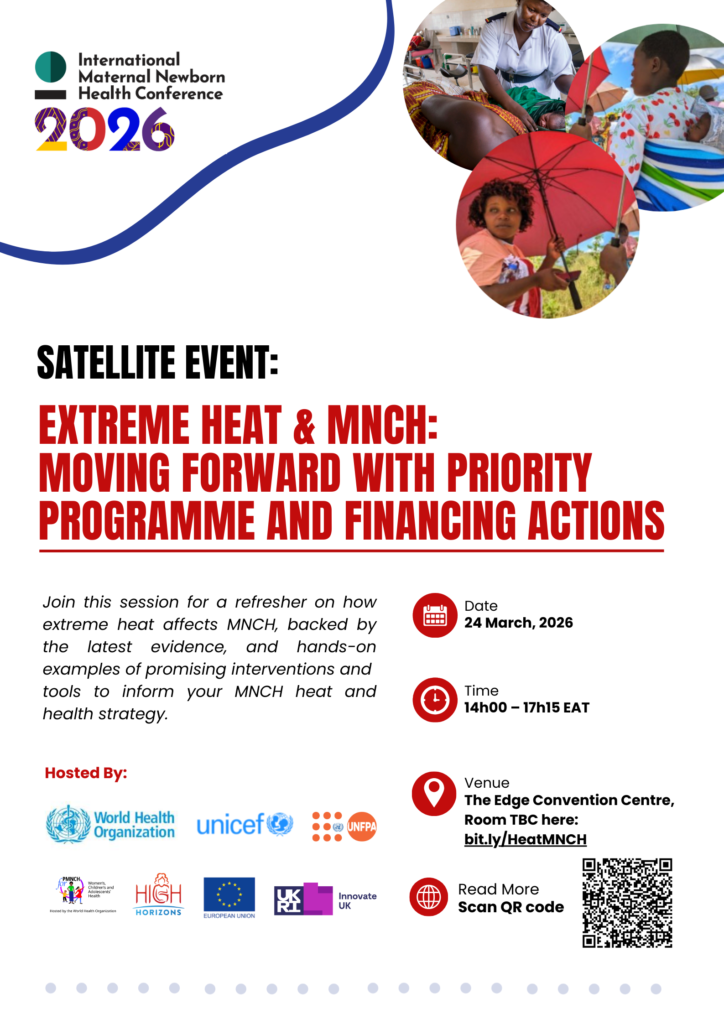
About the Session
Rising global temperatures are putting pregnant and postpartum women, newborns, young children, and the health workers who care for them at increasing risk. Studies show that pregnant women who experience heat exposure face higher risks of preterm birth, stillbirth, low birthweight, birth defects, gestational diabetes, and hypertensive disorders during pregnancy. Yet the impact of extreme heat on MNCH remains critically overlooked in heat health action plans and climate policy.
This session, organized by WHO, UNICEF, and UNFPA through a grant received by WHO as part of the HIGH Horizons project, will share recent data and identify priority actions to integrate MNCH into climate change and health efforts across policy, programming, and monitoring. Using interactive formats, it will bring together decision makers, health workers, and advocates to explore what can be done at every level of the health system.
The session will move through four interconnected themes:
- Understanding why heat exposure matters for MNCH
- Practical tools and country examples for programme managers,
- Financing options, and
- Pathways for integrating MNCH into broader national and global climate action.
Important topics include
Impacts of heat exposure on MNCH: A grounding in the latest evidence on how extreme heat affects maternal and newborn health outcomes and why urgent action is needed.
Economic impacts of extreme heat: Examining the wider financial and socioeconomic burden that heat places on women, households, and health systems.
Equipping people with the knowledge to reduce heat health risks: Exploring tools and approaches that empower pregnant women, mothers, and communities to protect themselves.
Impacts on health workers’ performance and quality of care: Looking at how heat affects the health workforce and what that means for the quality of care delivered to mothers and newborns.
Protecting health service users and health workers: Drawing on practical examples from South Africa and Zimbabwe on how health facilities can adapt to reduce heat risks for both patients and staff.
Our HIGH Horizons team
HIGH Horizons researchers and consortium members will also contribute across plenary presentations and roundtable discussions, sharing evidence and data and practical examples from ongoing work in Sub-Saharan Africa and beyond.
