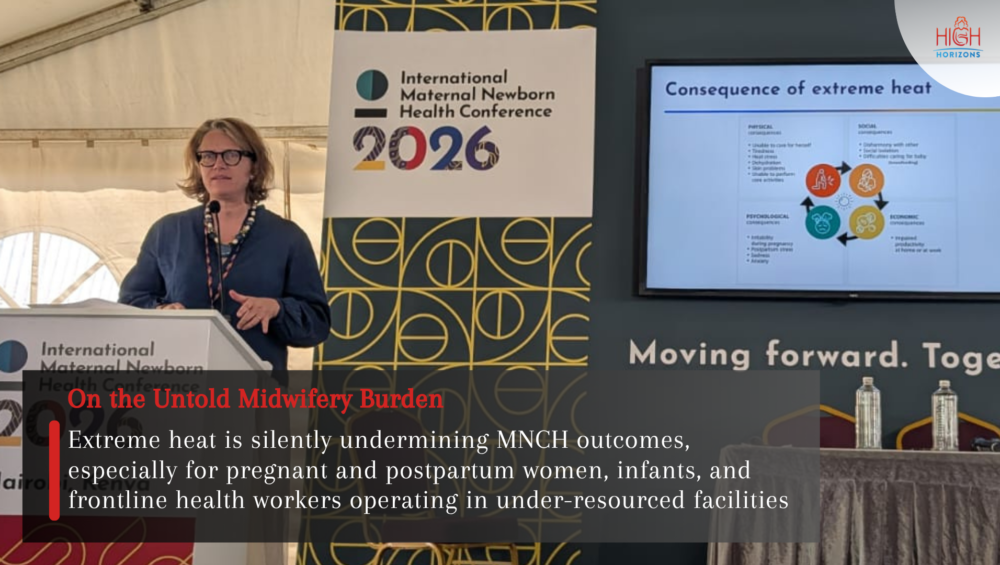
In March 2026, more than 1,800 delegates from several countries gathered at the Edge Convention Centre in Nairobi for the International Maternal Newborn Health Conference (IMNHC), held under the theme “Moving forward. Together.” Among the satellite sessions was one co-hosted by WHO, UNICEF, UNFPA and the HIGH Horizons consortium: “Extreme Heat and MNCH: Moving Forward with Priority Programme and Financing Actions.”
According to Giulia, it was the only session at the conference on climate change and the environment and the only one asking what rising heat does to women during pregnancy, to their newborns, and to the health workers who look after them.
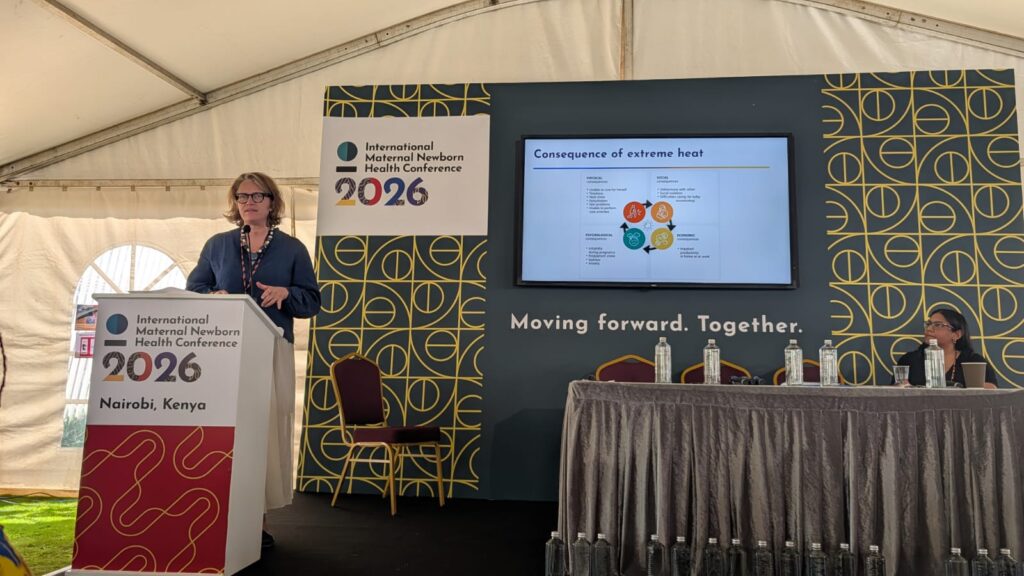
Giulia Greco is a health economist and one of the lead researchers in the HIGH Horizons consortium; she spoke on the session’s economics panel. We sat down with her afterwards for a brief chat that informed this piece.
The untold story in the delivery room
The room was full, she says, and unusually engaged, given that there were several parallel sessions. Part of what made it work was who was in it. The president of the Midwives Association of Kenya was there, alongside the International Confederation of Midwives, frontline providers, and researchers and funders.
Their contribution, Greco says, was to name something that rarely gets said out loud. “There was such an untold story about the stress that midwives are going through when they have to help women give birth, and they are burdened by the heat.” The conversation about extreme heat in maternity care tends to center on patients. It is also a story about challenging working conditions for the people helping to deliver the babies.
A fifth of her income
Greco’s own contribution to the session drew on joint work with her colleague Olimpia Lamberti on the combined economic burden of pregnancy, postpartum, and extreme heat on households. The headline estimate is blunt: roughly 20 – 30% of a woman’s monthly income goes on health-related and climate-related costs. A fifth of her income, that is, even before anything else in the house is paid.
“20% of the woman’s income goes to healthcare and climate-related expenses… The economic burden of climate and health is heavy. So, 20% is way above the catastrophic threshold.”
— Giulia Greco, HIGH Horizons
“Catastrophic” here is a technical term, but we will explain. In health economics, it marks the point at which paying for care forces a household to give up something else they need; it could be food, school fees, or seedlings for the next planting season. The most widely used international benchmark sits at 10% of household spending. Twenty percent is double it.
Put plainly: for the households in this analysis, staying healthy in a warming climate is not an expense that gets absorbed quietly. It is the kind of spending that pushes families backwards.
The money exists. The budgets are in the wrong shape.
Representatives of major funders, Unitaid and the Wellcome Trust among them, were clear that money is available for climate adaptation and health innovation. The obstacle is not the absence of finance. It is that health budgets and environment budgets are held separately, by ministries that plan separately, so a problem that sits across both falls between them.
What the session advocated for instead was co-financing: pooled funds and shared fiscal space across departments rather than a line item in one ministry’s plan.
Greco’s point is that the global health community has done it before and done it well: pooled, cross-departmental co-financing was how the response to HIV was built, and how COVID-19 and conflict responses were funded at speed.
“We are very good at pulling funding together and making funding available in times of crisis. So, we should really make funding available now also to reduce the effects of climate on health.”
— Giulia Greco, HIGH Horizons
The capability is proven. What is missing is the decision to treat heat and health as the same emergency.
Asked what interventions would reduce the burden, Greco sets out three, running from the financial to the domestic.
Climate-responsive social protection.
There is a conversation to be had with bodies like the International Labour Organization about extending social protection to cover climate risk, including insurance against climate-related hazards, also for unpaid workers. This is a live gap rather than a solved problem, and Greco is candid that the evidence base is thin: “We don’t have an intervention. It’s still very new, everything.”
Counting the costs that go uncounted.
In many countries, care during pregnancy and for children under five is free at the point of use. But free care is not free access. Transport to the facility, a day of income forgone, someone to mind the other children- these indirect costs are real, they are rising, and they are rarely in the policy. “Some governments might say our healthcare is free at the point of use, but they only consider the direct medical costs,” Greco says. “They don’t consider the indirect costs nor the opportunity costs. They could also include some of that.”
Shifting who carries the water.
The third is the hardest, because it is not a budget line. In heat-exposed regions, the heavy unpaid household work, such as walking long distances in full sun to fetch water and gathering firewood, falls to women, including women who are pregnant. Advising them to stay out of the heat is not advice anyone can act on. As Greco puts it, someone has to go and fetch the water. And if she doesn’t, it is usually her daughter, who may be a child.
“What if, actually, there can be a shift in the gender norms within the household and that can be carried out by the men?”
— Giulia Greco, HIGH Horizons
It is a question and we all know that norms move slowly, and change of this kind takes education and time. But it points at something the financing conversation can miss. Extreme heat does not fall evenly on a household. It follows the work. And in most households, the work that is most exposed to heat is women’s work.
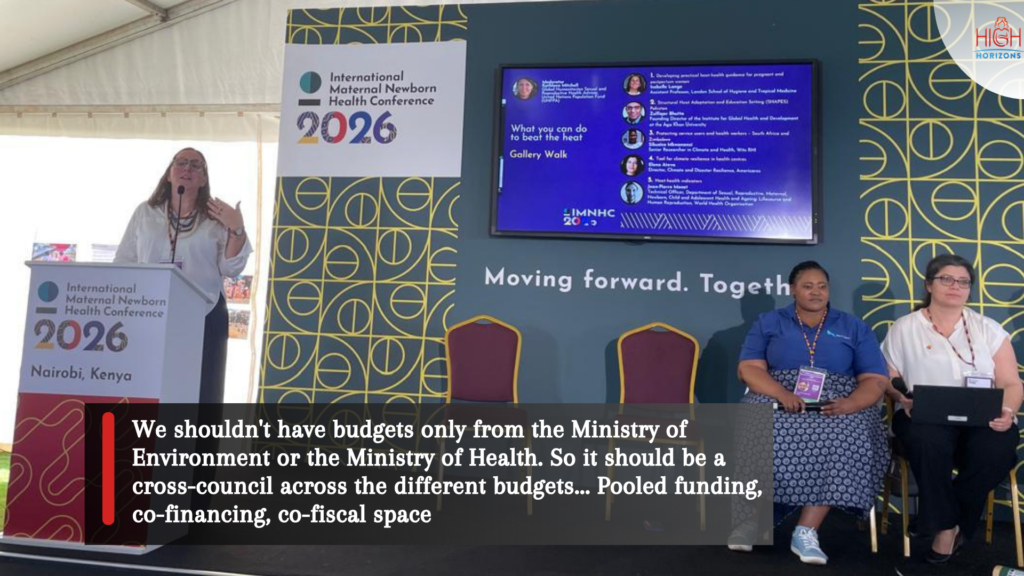
Isabelle Lange speaking at the HIGH Horizons satellite session, IMNHC 2026, Nairobi.
Why it matters
Climate, economics and health are not three problems. They are one, and it currently lands on the women least able to absorb it as a fifth of their income, as unpaid labour in rising temperatures, and as costs no policy is counting. If we want women to worry less about a pregnancy, the systems around them have to carry more of the risk.
- HIGH Horizons is an EU- and UKRI-funded research consortium working on extreme heat and maternal, newborn and child health.
This article is drawn from an audio interview with Giulia Greco and has been edited for length and clarity.