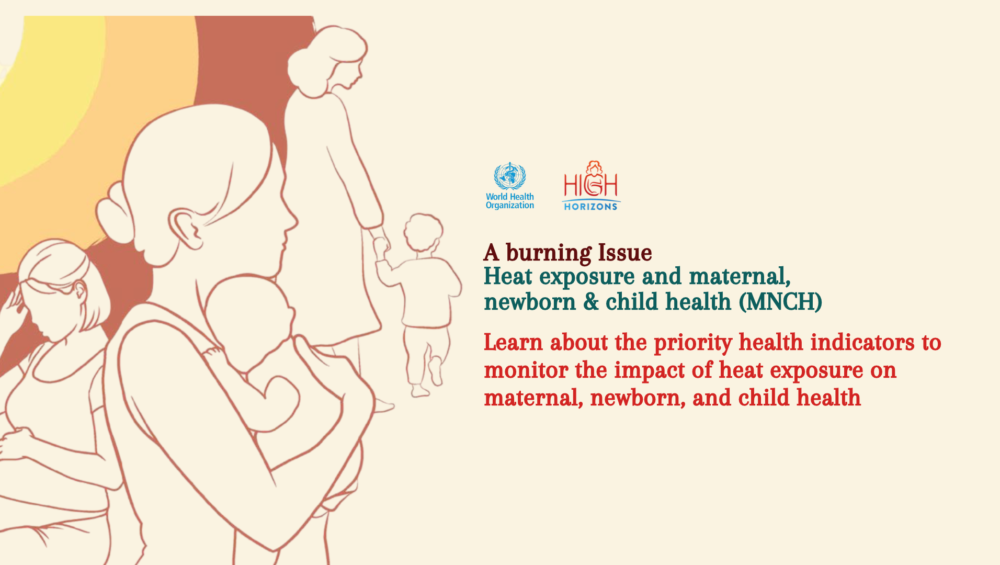
As global temperatures rise, heat exposure has become an urgent issue for maternal, newborn, and child health (MNCH), especially where temperatures are already high and in resource-limited settings where the infrastructure to reduce heat stress is constrained. Yet health systems have lacked a common way to measure this risk and track progress in addressing it.
On Wednesday, 21 October 2026, the World Health Organization (WHO) and HIGH Horizons hosted a webinar to launch a new joint publication by WHO, the World Meteorological Organization (WMO), the United Nations Children’s Fund (UNICEF), and the United Nations Population Fund (UNFPA) on priority indicators to measure the impact of heat exposure on MNCH, alongside a related policy brief.
HIGH Horizons was proud to co-host the webinar with the participation of global networks and health professional associations: Every Woman Every Newborn Everywhere (EWENE), the Council of International Neonatal Nurses (COINN), the Early Childhood Development Action Network (ECDAN), the International Federation of Gynaecology and Obstetrics (FIGO), the International Confederation of Midwives (ICM), the International Pediatric Association (IPA) and the International Society for Social Pediatrics and Child Health (ISSOP).
About the webinar
Pregnant and postpartum women, newborns, and children are uniquely vulnerable to climate risks because of a range of anatomical, developmental, physiological, and behavioral factors. Health facilities are also under strain: evidence from HIGH Horizons’ baseline studies in birth rooms and neonatal wards in South Africa and Zimbabwe show that extreme heat affects staff well-being, increases fatigue, compromises fine motor tasks, and lengthens patient waiting times.
The webinar presented the latest evidence on the impact of heat on MNCH and introduced the new priority indicators as a framework to assess progress and inform programming. Partners also shared practical actions to build climate-resilient health systems and reduce heat in health facilities. Through live polls, rapid-fire statements from professional associations, and a multi-partner panel, the session brought together voices from ministries of health, professional associations, health facility managers, health workers, and international organizations.
Resources
The following link takes you to the indicator document, the two meeting reports, the policy brief, and the conceptual framework [Click on the link to view]
We have attached a document below with other resources shared during the webinar. We hope they support your work, whether you plan services, manage a facility, care for women and children, or shape policies.