Prof Sibusiso Mkwananzi | Climate and Health Programme, Wits RHI
Attending the 3rd Conference on the Impact of Climate Change on Health in Maputo, Mozambique, was both a rewarding scientific experience and an opportunity to reflect on how far we have come in advancing climate and health research in Africa. The conference brought together researchers, policymakers, public health practitioners and development partners to share evidence, exchange experiences and explore practical responses to the growing health consequences of climate change.
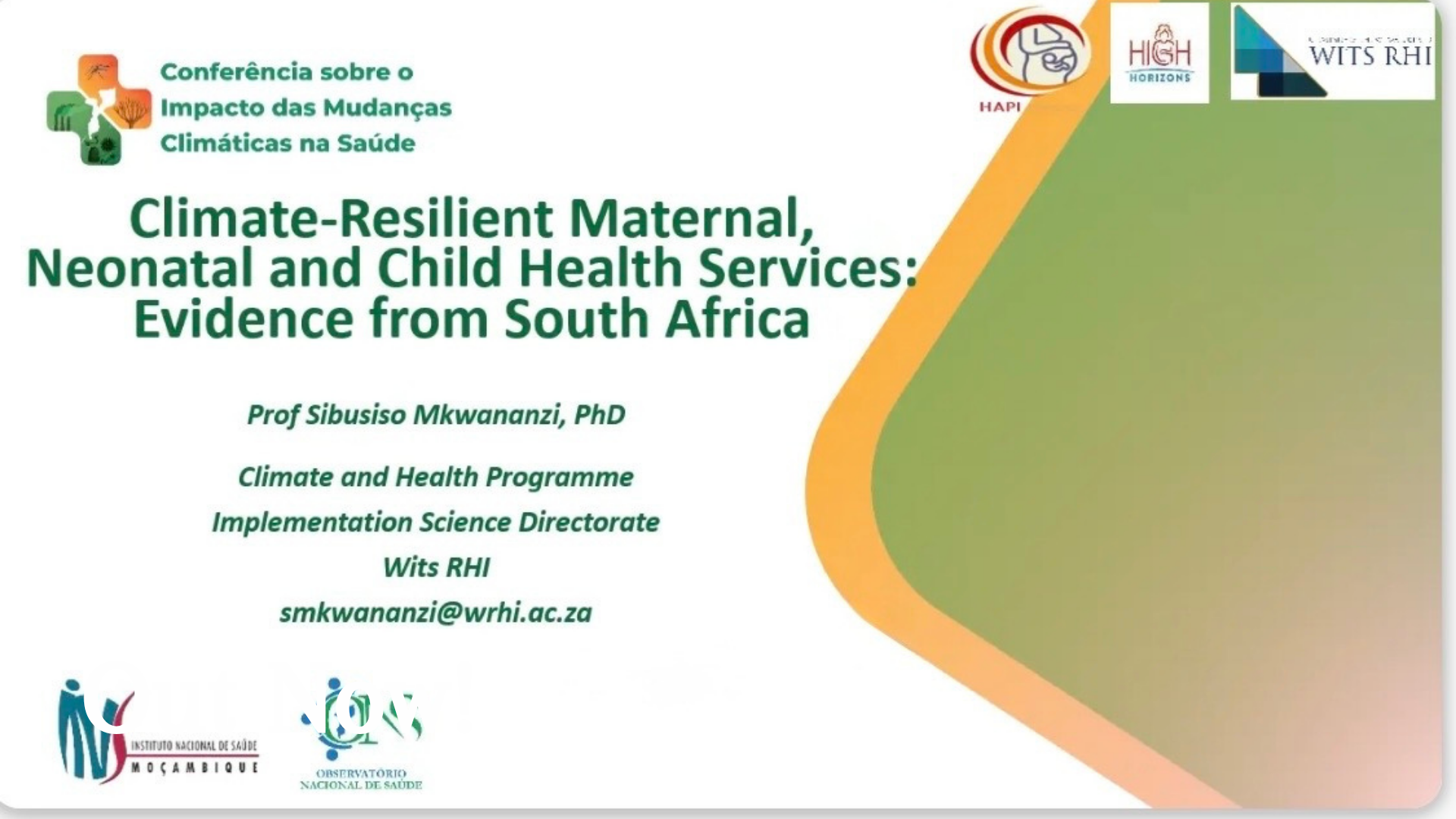
What I appreciated most was the strong emphasis on moving beyond describing climate-related health risks towards identifying solutions that can be implemented in communities and healthcare systems. It was encouraging to engage with colleagues from different disciplines and countries, all contributing to understanding human health in a changing climate. I was honored to be invited as a plenary speaker, presenting on “Climate-Resilient Maternal, Neonatal, and Child Health Services: Evidence from South Africa.” Drawing on our experiences from the Heat Indicators for Global Health (HIGH Horizons) and Heat Adaptation for Pregnant Women and Infants (HAPI) projects, I shared evidence on the effects of extreme heat on vulnerable populations and, importantly, what we have learned about interventions that can strengthen resilience in households and healthcare facilities.
It was also a proud moment for our Climate and Health Programme at Wits RHI, with four scientific abstracts accepted for presentation at the conference. Here, I had the opportunity to present a scientific paper on the effective of the MotherHeat Alert app’s effectiveness in decreasing dehydration among pregnant and postpartum mothers, while my colleague, Dr Glory Chidumwa, showcased a HAPI-linked poster examining indoor heat exposure among pregnant and postpartum women living in informal settlements in Tshwane, South Africa.
When the Wits RHI team began implementing HIGH Horizons and HAPI, we were seeking to understand not only the health risks associated with extreme heat but also whether practical interventions could be introduced and evaluated in resource-constrained African settings. Today, having completed all data collection across both projects, we are in a much stronger position to contribute evidence on what can work, under which circumstances, and what challenges need to be addressed during implementation. Through HAPI, our research has demonstrated that indoor environments can expose pregnant and postpartum women to considerably higher temperatures than those recorded outdoors. We have also assessed individual, household, health facility, and community adaptation measures, including nature-based, behavioral, and structural interventions. These findings are helping us better understand how relatively affordable interventions can reduce exposure and support protective behaviors among vulnerable women.
Similarly, HIGH Horizons has provided important lessons on strengthening climate resilience within maternal and newborn healthcare services. Through nature-based, behavioral, and structural interventions such as healthcare worker training and heat early warning and response information, we have been able to examine both the practical feasibility of these approaches and how they are received and used by healthcare workers and patients.
One lesson that has become increasingly clear is that climate-resilient healthcare requires more than infrastructure improvements alone. It also requires informed healthcare workers, appropriate institutional responses, supportive management and interventions that can be sustained within the realities of everyday service delivery. The discussions in Mozambique reinforced how relevant these lessons are beyond South Africa. Across the region, many countries face similar challenges of increasing temperatures, limited resources, vulnerable communities, and health systems already managing competing demands. Sharing experiences across countries creates opportunities to learn from one another rather than repeatedly starting from the beginning.
The timing of the conference also felt particularly important. With concerns about the potential effects of El Niño on Southern Africa, against the broader background of continued global warming, the need for evidence-based heat adaptation has become increasingly urgent. We cannot afford to wait until extreme heat events overwhelm communities and healthcare facilities before considering how best to protect those at greatest risk. For me, this is where the value of implementation research projects such as HAPI and HIGH Horizons becomes particularly evident. We are moving from identifying vulnerabilities to providing practical evidence that can inform decisions about climate adaptation in low-resource settings. Although important questions remain about long-term effectiveness, sustainability, and wider implementation, we now have experience and findings that can help guide the generation, implementation, and scaling of heat adaptation interventions.
Beyond the scientific presentations, I valued the opportunity to connect with colleagues who share our commitment to translating research into public health action. Conferences such as this remind us that research has its greatest value when it informs decisions, strengthens partnerships, and ultimately improves people’s lives. I also left Mozambique feeling immensely proud of our team at Wits RHI and grateful to the communities, healthcare workers, collaborators, and funders who have contributed to this work. The progress we have made through HAPI and HIGH Horizons reflects years of collective effort, persistence, and learning, often under challenging implementation conditions. As I reflect on the conference, I am reminded that completing research projects is not the end of our responsibility. It is the beginning of the next important phase: ensuring that the evidence we have generated reaches policymakers, health system managers, and communities and contributes to interventions that can be implemented at scale.
We have come a long way as a Climate and Health Programme, but there is still much work ahead. As our world continues to warm, I hope that the evidence and partnerships we are building will help ensure that climate resilience becomes an integral part of maternal, neonatal, and child healthcare, particularly for those who have the fewest resources to protect themselves. That, for me, is the real measure of progress in climate and health research.
Click the links below to view our projects.